

What to Look for in a B2B Manufacturer of Custom Branded Vacuum Insulated Water Bottles
Choosing the right B2B manufacturer for custom branded vacuum insulated water bottles is a strategic decision that impacts your brand image, customer satisfaction, and long‑term profitability. The supplier you select will influence your product quality, lead times, pricing, and even your ability to launch new designs on schedule.
Using Senyhua — a professional stainless steel drinkware manufacturer and supplier — as a reference point, this guide explains the key criteria you should evaluate before committing to a B2B manufacturing partner.
1. Manufacturing Experience and Focus on Drinkware
Start by examining how specialized the manufacturer is in vacuum insulated drinkware. A supplier that has years of experience specifically in stainless steel bottles, tumblers, and flasks will generally offer more stable quality and mature production processes.
- Industry experience: Look for a manufacturer with a proven history in producing vacuum insulated bottles, mugs, tumblers, and travel flasks for global brands.
- Product focus: A portfolio centered on stainless steel drinkware, rather than a mix of unrelated products, suggests deeper technical know‑how in insulation, welding, and surface treatments.
- Global market familiarity: Check if they already supply North America, Europe, or other demanding markets, as this usually means familiarity with stricter quality and compliance standards.
Senyhua, for instance, presents itself as a professional manufacturer dedicated to stainless steel water bottles, vacuum flasks, travel mugs, and related products, signaling clear industry focus.
2. Material Quality and Insulation Performance
For vacuum insulated bottles, material and structural integrity directly determine performance. A good B2B manufacturer should clearly specify materials and insulation expectations.
Key material and construction factors
- Stainless steel grade: Prefer food‑grade stainless steels such as 304 (18/8) or 316, which offer corrosion resistance, flavor neutrality, and durability.
- Double‑wall vacuum structure: Confirm that bottles use true double‑wall vacuum construction and not just single‑wall or foam‑insulated designs.
- Insulation performance claims: Your supplier should be able to state heat/cold retention times (for example, keeping beverages hot for 12 hours or cold for 24 hours) and provide test data.
- Inner surface treatment: Food‑contact surfaces should be smooth, easy to clean, and resistant to stains and odors.
On a professional manufacturer’s website, you should find product specifications, capacity details, material descriptions, and insulation performance claims for each model.
3. OEM/ODM Capability for B2B Projects
If you are building a customized or private‑label line, OEM (Original Equipment Manufacturer) and ODM (Original Design Manufacturer) capabilities are crucial. This is an area where Senyhua, as a custom drinkware provider, highlights its strengths.
What solid OEM/ODM capability looks like
- Design support: Ability to assist with bottle shape, structure, and functional design (e.g., lids, straws, handles, filters).
- Engineering team: In‑house engineers and designers who can translate your concepts and drawings into 3D models and production‑ready molds.
- Tooling and mold development: Capacity to develop custom molds for unique bottle bodies, lids, and accessories.
- Sample development: Clear process and timeline for prototype and pre‑production sample creation.
Before selection, ask potential manufacturers to share examples of previous OEM/ODM projects, including custom bottle shapes, proprietary lids, and brand‑specific accessories.
4. Custom Branding and Decoration Options
Your brand identity on the bottle is just as important as the bottle itself. The manufacturer should offer a comprehensive range of branding options with consistent, repeatable results.
Common customization methods to look for
- Silk screen printing: For simple logos and single‑ or limited‑color graphics.
- Laser engraving: For durable, premium‑looking branding that won’t peel or fade; ideal for stainless steel surfaces.
- Heat transfer / pad printing: For more complex or multicolor designs.
- Powder coating and painting: To achieve a wide range of colors and finishes (matte, glossy, textured).
- Sublimation or digital printing: For full‑color, photo‑quality wraps where applicable.
Check if the manufacturer can show you their color library, finish options, and a gallery of previous branded projects. Senyhua, for example, showcases different surface treatments and printing techniques across its stainless steel bottle range.
5. Quality Control and Certifications
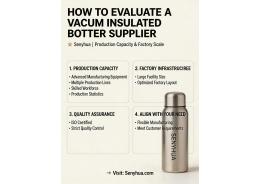
Quality control is non‑negotiable for B2B buyers. You need assurance that every production batch meets consistent standards and relevant regulations in your target markets.
Areas to assess
- Incoming material inspection: Verification of stainless steel, plastics, and coatings before use.
- In‑process checks: Leak testing, vacuum integrity testing, and lid fit testing throughout production.
- Final product inspection: Random sampling according to AQL (Acceptable Quality Limit) standards.
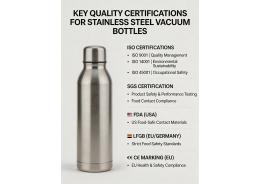
- Food‑contact safety: Compliance with EU, FDA, LFGB, or other relevant regulations for materials in contact with beverages.
- Factory certifications: ISO 9001 or similar quality management certifications, if available.
Ask suppliers for test reports, quality certificates, and inspection procedures. A professional manufacturer will be able to share documented QC processes and sample reports from previous orders.
6. Product Range and Flexibility
A diverse product range gives you more flexibility in building a cohesive branded collection. When assessing a B2B manufacturer, review their catalog carefully.
Elements of a strong product portfolio
- Multiple capacities: From small 350–500 ml daily bottles to 750 ml, 1 L or larger sports and outdoor bottles.
- Different formats: Standard bottles, sports bottles, travel mugs, coffee tumblers, kids bottles, and flasks.
- Variety of lids: Screw caps, flip lids, straw lids, spouts, and leak‑proof travel lids.
- Accessories: Handles, carabiners, sleeves, gift boxes, and custom packaging.
Senyhua’s catalog, for example, spans stainless steel water bottles, tumblers, travel mugs, and flasks, giving B2B clients the option to build a multi‑SKU product line with one supplier.
7. Minimum Order Quantity (MOQ) and Pricing Structure
For B2B projects, MOQ and pricing can determine whether a cooperation is viable, especially for new or niche product lines.
Points to clarify
- MOQ per style and color: Understand the minimum units required for each design, color, and branding variation.
- Price tiers: Ask for price breaks at different volume levels and how unit cost changes with customization complexity.
- Mold and setup charges: If you need a new shape or lid design, confirm one‑time tooling costs and how they can be amortized.
- Sample pricing: Clarify whether samples are free, discounted, or fully charged, and how sample cost may be credited against bulk orders.
Professional manufacturers are usually transparent about MOQs and will suggest existing molds or semi‑custom options if your initial volume is limited.
8. Lead Times, Capacity, and On‑Time Delivery
Reliable delivery is essential. Late shipments can disrupt your product launches and marketing campaigns, especially for seasonal or promotional programs.
What to evaluate
- Production lead time: Typical lead times for standard orders and custom orders (including branding and packaging).
- Sample lead time: How long it takes to get a custom sample ready for approval.
- Monthly production capacity: Whether the factory can support your initial demand and scaling needs.
- Logistics support: Experience with international shipping, export documentation, and coordination with freight forwarders.
A manufacturer like Senyhua that regularly serves overseas clients will generally have established processes for export, packaging optimization, and coordination of shipment schedules.
9. Communication and Customer Service
Good communication can significantly reduce project risk, especially when you are customizing products. The ideal manufacturer acts as a partner, not just a vendor.
Signs of strong service
- Responsive sales team: Quick replies to inquiries, quotes, and technical questions.
- Professional advice: The ability to suggest more suitable materials, structures, or printing methods based on your goals.
- Clear documentation: Detailed quotations, drawings, and confirmations before production.
- After‑sales support: A clear policy for handling defects, returns, and re‑orders.
Before placing a large order, test the supplier’s responsiveness by engaging in detailed discussions about specifications, lead times, and production details.
10. Compliance, Sustainability, and Brand Alignment
More brands are emphasizing sustainability, safety, and ethical sourcing. Your manufacturer should help you meet those expectations, not compromise them.
Areas to discuss
- Material safety: Confirm that all materials are BPA‑free and compliant with relevant food‑contact regulations.
- Environmental considerations: Ask about the use of recyclable materials, eco‑friendly coatings, and packaging solutions.
- Factory practices: Where possible, confirm that the production environment respects labor, safety, and environmental standards.
Manufacturers with long‑term partnerships in Europe and North America, such as Senyhua, are typically familiar with stricter requirements in these areas and can help you navigate compliance documentation.
11. Why Consider Senyhua as a Reference Manufacturer
Senyhua illustrates many of the qualities described above for a strong B2B partner in vacuum insulated drinkware:
- Specialization in stainless steel water bottles, tumblers, and travel mugs.
- Capability for OEM/ODM projects, including custom shapes and branding.
- Multiple surface treatments and logo options (printing, engraving, coating).
- Export experience supplying overseas markets with custom drinkware solutions.
When you evaluate any potential supplier, including Senyhua, use the checklist from this article to structure your questions and requirements.
12. A Practical Checklist for Selecting Your B2B Bottle Manufacturer
To streamline your decision process, use this quick checklist when talking with candidates:
- Do they specialize in stainless steel, vacuum insulated drinkware?
- Can they support OEM/ODM design, including custom molds and accessories?
- What stainless steel grades and insulation performance do they offer?
- What logo and surface treatment options are available?
- What QC processes and certifications do they have?
- What is their MOQ and pricing structure for custom branding?
- What are sample and mass production lead times?
- How strong is their communication and after‑sales support?
- Can they provide compliance and test reports for your target markets?
Conclusion
Finding the right B2B manufacturer of custom branded vacuum insulated water bottles is about more than just getting a low price. You need a partner with reliable quality, strong OEM/ODM capabilities, flexible customization, and professional service.
By evaluating suppliers against the criteria outlined in this guide and studying experienced drinkware manufacturers like Senyhua, you can select a partner who helps you build a durable, attractive, and profitable product line that truly represents your brand.

 English
 German
 French
 Russian
 Spanish
 Japanese
 Korean
 Portuguese
 Ukrainian
 Arabic
 Italian


